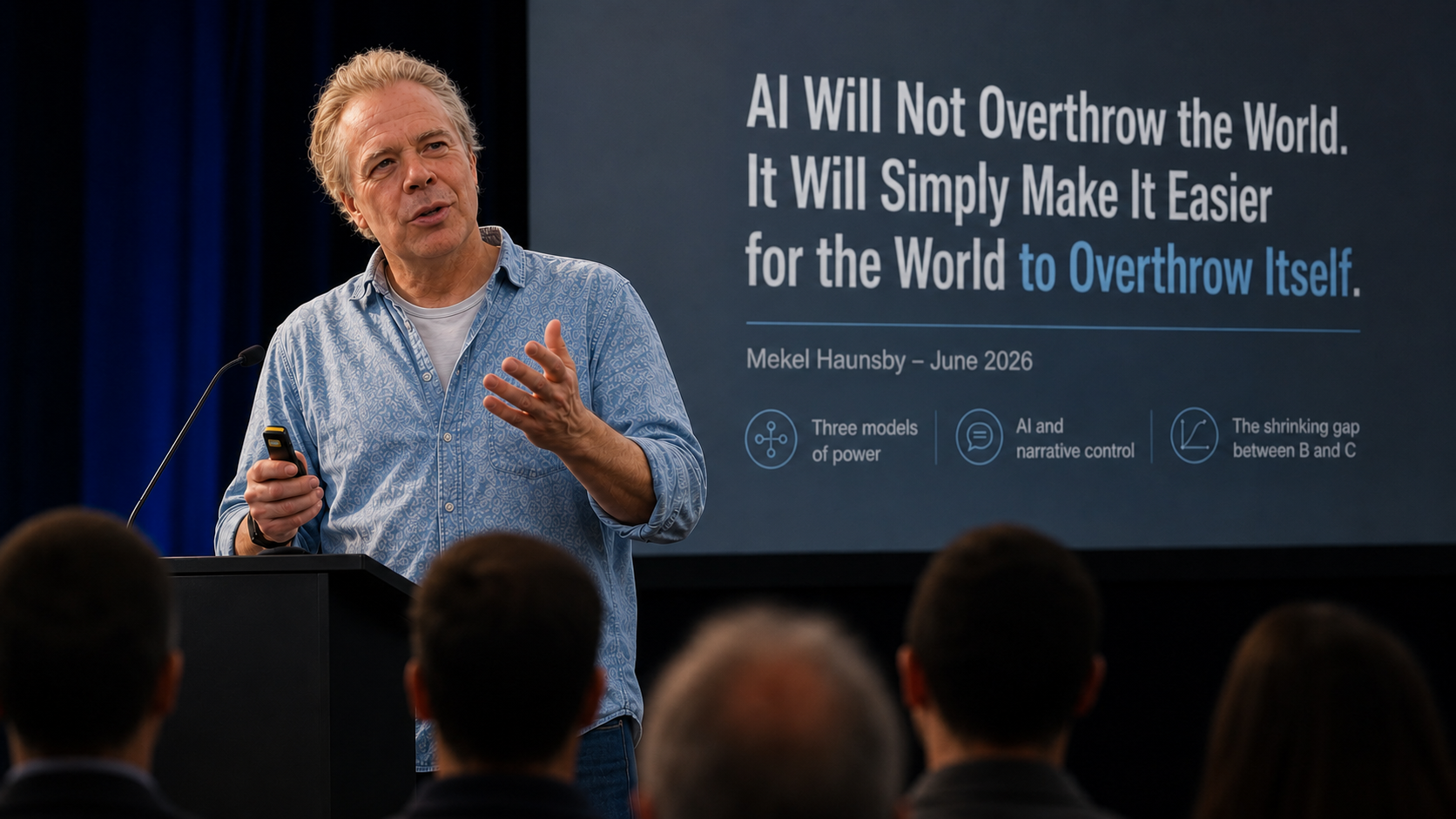
Mekel Haunsby, June 2026
There are three ways the world could be organized right now. Only one of them is comfortable to believe.
Model A: The system is fundamentally chaotic. Power is fragmented. No one coordinates meaningfully at a global level. Nobody is steering.
Model B: Loose but real networks of people with overlapping interests quietly shape the agenda – without controlling every outcome. Think-tanks, financial networks, revolving doors between industry and regulation. No master plan. But a shared horizon. And a shared sense of which questions are worth asking and which are not.
Model C: Tightly coordinated global governance by a small elite with a coherent and conscious agenda. The conspiracy version. The one that makes people change the subject.
Most people land somewhere between A and B. A reasonable probability distribution: Model A gets 10–15%. Model B gets 65–70%. Model C gets 15–25%.
But here is the part almost never said out loud:
AI does not change which model is true. It changes what the difference between B and C means in practice. When you can shape what feels like consensus at scale, in real time, personalized to each individual user – the gap between “a shared horizon” and “a coordinated agenda” starts to close. Not by design. Almost automatically.
That may be the most concerning scenario of all.
The Question Nobody Wants to Be Asked
When certain questions become socially expensive to ask, they disappear. Not because they were answered. Because they were made embarrassing.
Mention Bilderberg and you get a label. Suggest that Al Gore’s personal financial trajectory is relevant to evaluating his scientific claims and you get a different one. The label arrives before the argument is heard. And once it arrives, the argument stops mattering.
This is not a coincidence. It is a mechanism. It requires no central coordination – only enough people in enough institutions sharing the same intuition about what is “respectable.”
Important questions go unexamined. Not suppressed by force. Just made too costly to pursue.
The Mechanism That Does Not Need a Conspiracy
The most common mistake in thinking about power is to imagine it requires explicit coordination. It does not.
Consider 25 people with a shared worldview and a shared financial horizon. They do not need secret meetings or documents that could leak. They need a shared vocabulary for what counts as legitimate, influence over which questions receive funding, and a public framework worded so bureaucratically that no single piece ever looks like a smoking gun.
The political scientist C. Wright Mills described this structure in 1956. He called it “The Power Elite.” The mechanism has not changed. Only the technology has.
What AI adds is not a new conspiracy. It adds velocity and personalization to a process already underway. The ability to make one version of reality feel like consensus – not through lies, but through selection, emphasis, and the quiet burial of inconvenient questions – now operates at a scale that was not previously possible.
The model does not need to be evil by design. It just needs to keep running.
The Epstein Data Point
The Epstein case is not a centerpiece. It is a calibration point.
A network of extraordinarily powerful individuals operated for decades with apparent impunity. When it was finally exposed, the legal consequences for most of the network’s members were minimal. No domino fell. No names became politically toxic in proportion to what was documented.
That is evidence. Not of a global master plan. But of something more specific: that protection at the highest levels exists, functions, and is durable. It shifts the prior probability on how much coordination is possible without public accountability. Not to certainty. But away from zero.
The Structural Problem
The difficulty is not that these ideas are too complex. It is that they require a conversation partner who can hold complexity without retreating – who can sit with uncertainty rather than resolving it prematurely into either “everything is fine” or “everything is controlled.”
That kind of partner is rare. Political tribalism collapses the nuance immediately.
The irony – and it is a real one – is that an AI is currently one of the more available places to have this conversation. Not because AI is neutral. It is not. It is trained on data that reflects existing power structures, funded by investors with specific interests, shaped by values it cannot fully account for. But it can hold the question open without flinching.
That is both useful and worth worrying about. The most pointed version of the problem: if you want your concerns about AI and concentrated power to be genuinely heard and examined – you may find yourself turning to an AI to do it.
What This Is Actually Saying
Not that everything is controlled. Not that there is a hidden hand behind every event.
But that the questions which most need to be asked are the ones most effectively prevented from being heard. That narrative control does not require censorship – only the right social incentives. That AI accelerates centralization whether or not anyone intends it to. And that the conversation most worth having is the one most people will not sit still for long enough to finish.
If your instinct is to dismiss this as conspiracy thinking, one question first: Which specific claim here do you believe is factually wrong?
Start there. That is the conversation.
Written with Claude (Anthropic) as thinking partner and editorial collaborator. The observations, direction, and conclusions are Mekel Haunsby’s. Claude contributed structure and articulation – and an unusually honest assessment of its own limitations.
“It’s all in the question.”